You never decided to lose four hours a day. You picked up your phone to check one thing, and surfaced twenty minutes later, somewhere you didn't mean to be. That isn't weakness. It's the product working exactly as intended.
If you've ever ended a day wondering where it went, promised yourself tomorrow would be different, and watched tomorrow play out exactly the same, this is for you. The story we're told about screen time is a story about character: disciplined people put the phone down, the rest of us scroll. That story is wrong, and believing it is part of what keeps you stuck.
The numbers nobody chose
The apps you use most are tuned, tested and shipped to keep you scrolling. The result is remarkably consistent from person to person, and the scale is hard to take in until you see it laid out:
In 2024, the average American checked their phone 205 times a day, about once every five waking minutes, a 42% jump in a single year, according to Reviews.org's annual survey. More than 80% of people reach for the phone within ten minutes of waking, before they've had a thought that was their own.
None of those numbers describe a personal failing. They describe a population responding, predictably, to the same set of incentives.
Attention is the product, and you're not the customer
Most of the apps competing for your evening are free. That should be the tell. When a product is free, the business model is usually attention: your minutes are gathered, packaged and sold to advertisers, and the company that gathers the most wins. That isn't a conspiracy theory. It's the stated revenue model of the largest platforms on earth.
Once attention is the product, every design decision bends toward holding it longer. Three patterns do most of the work:
- The infinite feed. There is no bottom, so there is no natural stopping cue. A page that ends gives you a moment to decide whether to continue; a feed that never ends never offers that moment.
- Variable rewards. You pull to refresh and sometimes something good appears. Intermittent, unpredictable payoff is the same mechanism that makes slot machines compulsive: psychologist B. F. Skinner showed decades ago that a variable reward schedule drives the most persistent behavior of all.
- Manufactured urgency. Streaks, "active now" dots, and red badges convert ordinary moments into small emergencies you feel obligated to resolve.
The asymmetry
On one side of the screen: you, tired, at the end of a long day. On the other: teams of engineers, designers and data scientists running continuous experiments on millions of people, with the explicit goal of capturing more of your time. It is not a fair fight, and it was never designed to be.
Willpower is the wrong tool
Here's the trap. Because the loss feels like your loss, your evening, your focus, your intention, the obvious fix feels like more of you: more discipline, more willpower, a firmer promise tomorrow. So you try to "just use it less."
You will lose most days. Not because you're weak, but because willpower is a finite, depletable resource that's lowest exactly when you need it most: late at night, stressed, bored, lonely. Asking a worn-out brain to out-argue a system engineered to win that argument is a plan that fails on schedule.
And the cost isn't only the minutes you spend looking. It's the wreckage each interruption leaves behind. Research by Gloria Mark at the University of California, Irvine found it takes an average of 23 minutes and 15 seconds to fully return to a task after being pulled away. The American Psychological Association estimates that toggling between tasks can eat up to 40% of someone's productive time. A "quick check" is never quick. The real cost is everything that happens after you put the phone down.
Stop relying on willpower. Put a wall between you and the app.
Friction beats willpower
If discipline is the wrong tool, what's the right one? Design. The same principle the apps use against you works just as well in your favor. You simply put the friction on the other side.
Behavioral scientists call this a commitment device: a choice you make in a calm moment that constrains the choices you'll make in a weak one. Odysseus had himself tied to the mast so the sirens couldn't win in the moment. You don't need rope. You need the distracting thing to be harder to reach than it is to resist, and you need that barrier to live somewhere a tired hand can't quietly undo.
That last part is where most tools fall down. A screen-time limit or an app blocker lives on the same phone you're trying to escape, and its off switch is two taps away. A barrier you can disable in the exact moment you most want to disable it isn't really a barrier. It's a speed bump you've already learned to ignore. Here's how the disc compares to the software blockers, point by point.
One scan, and they're gone
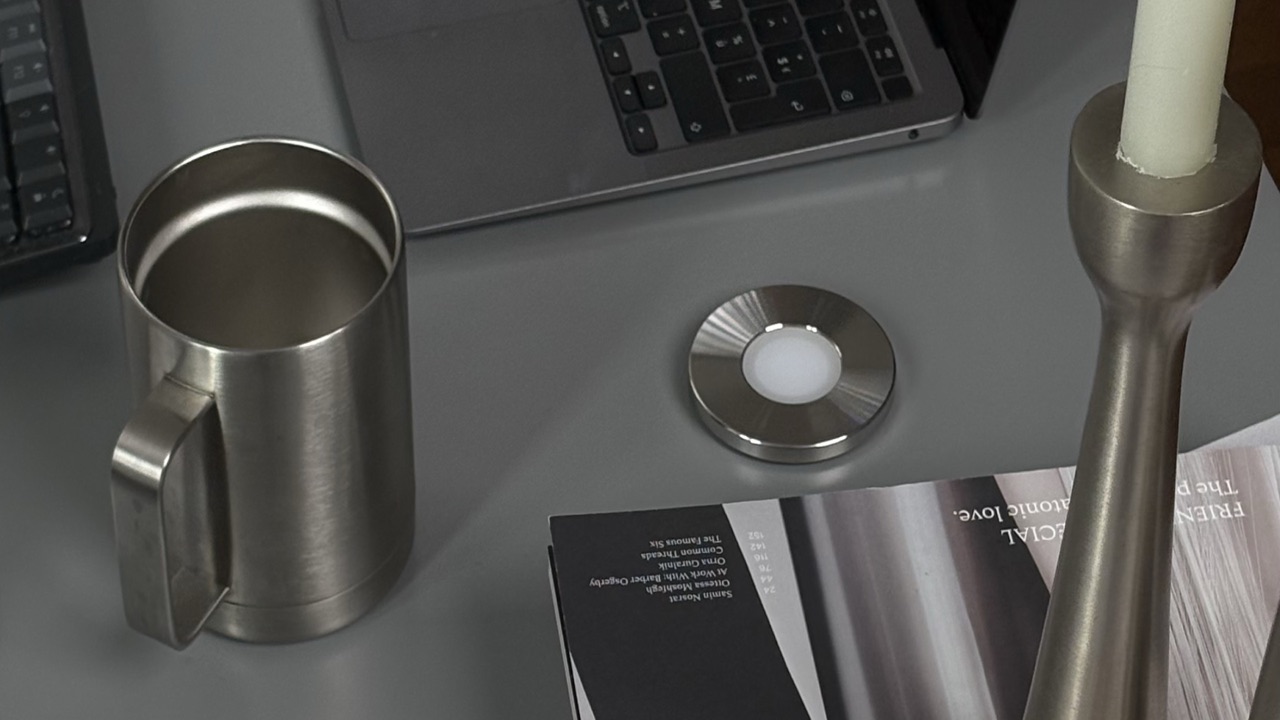
Norma is a stainless-steel disc. You decide once which apps disappear, then scan the disc with your iPhone to switch the block on, and scan again to bring them back. No timer to argue with, no setting to talk yourself out of, no subscription quietly renewing in the background.
The mechanism is deliberately boring: the disc holds a passive NFC tag, the same technology behind tap-to-pay, and a scan flips your chosen apps off in under a second. What matters isn't the chip. It's where the off switch lives: not on the screen, but on the object.
Why a disc
A toggle lives inside the same phone you're trying to escape. A disc lives on your desk, by your bed, or in another room entirely. The friction is the feature: reaching for it is a small, deliberate choice, the exact opposite of an absent-minded tap. Leave it in the kitchen and the block simply stays on, because the only way to lift it is to physically go and get it.
it's a beautiful object paired with a beautiful app that helps you honor your beautiful intentions… go out and order one now
Get the hours back
Reframing this isn't about letting yourself off the hook. It's about pointing your effort somewhere it can actually win. You were never going to out-discipline a thousand-person product team. You can, easily, out-design them in your own home: move the switch off the screen, and the weak moment has nothing to act on.
You won't notice the four hours leaving. You will notice them coming back: a clearer evening, a finished piece of work, a dinner you were actually present for.
Questions, answered.
- Why is my screen time so high?
- Because the apps you use most are tuned, tested and shipped to keep you scrolling, and the result is remarkably consistent from person to person. In 2024 the average American checked their phone 205 times a day, about once every five waking minutes, according to Reviews.org's annual survey. The cost is not only the four-plus hours in front of the screen: research by Gloria Mark at the University of California, Irvine found it takes an average of 23 minutes and 15 seconds to fully return to a task after being pulled away.
- Are apps designed to be addictive?
- They are designed to hold your attention for as long as possible, which is a design goal rather than a diagnosis. Most of the apps competing for your evening are free, and when a product is free the business model is usually attention: your minutes are gathered, packaged and sold to advertisers. That is not a conspiracy theory; it is the stated revenue model of the largest platforms on earth.
- What are dark patterns in apps?
- It is the usual shorthand for interface choices built to serve the product's goal of holding your attention rather than your own intention. Three of them do most of the work: the infinite feed, which leaves no natural stopping cue; variable rewards, where you pull to refresh and something good only sometimes appears; and manufactured urgency, in the form of streaks, “active now” dots and red badges.
- Why can't I stop using my phone?
- Because willpower is the wrong tool for the job. It is a finite, depletable resource that is lowest exactly when you need it most: late at night, stressed, bored, lonely. Asking a worn-out brain to out-argue a system engineered to win that argument is a plan that fails on schedule.
- Is infinite scroll intentional?
- Yes. A feed with no bottom leaves no natural stopping cue: a page that ends gives you a moment to decide whether to continue, and a feed that never ends never offers that moment. It works alongside variable rewards: psychologist B. F. Skinner showed decades ago that a variable reward schedule drives the most persistent behavior of all.
- Is my screen time my fault?
- No. What you are up against is design, not character: teams of engineers, designers and data scientists running continuous experiments on millions of people, with the explicit goal of capturing more of your time. You were never going to out-discipline a thousand-person product team, but you can out-design them in your own home by moving the off switch off the screen. Norma is one way to do that: a stainless-steel disc you scan with your iPhone to switch the block on, and scan again to bring the apps back.
Quiet your phone for good.
One scan blocks the apps you choose, until you scan again.
Sources
- 1.Reviews.org · Cell Phone Usage Statistics (2024 survey: 205 checks/day; 80%+ check within 10 minutes of waking)
- 2.Gloria Mark et al., UC Irvine · “The Cost of Interrupted Work: More Speed and Stress,” CHI 2008 (23 min 15 s to refocus)
- 3.American Psychological Association · “Multitasking: Switching costs” (up to 40% of productive time)
- 4.Reviews.org · Internet & Screen-Time Statistics (average daily smartphone screen time)